The Empathic Turn: Emotion, Design, and Digital Companionship (2010s–Present)
The 1990s proved software could deliver a structured technique like CBT without a person driving it. What they hadn't proven, what nobody had even seriously attempted, was software that could handle the other half of therapy: the responsive, emotionally attuned relationship that a technique alone was never supposed to replace. The 2010s are when AI stopped respecting that boundary. Rosalind Picard's work on affective computing (Picard, 1997, 2010) gave machines a genuine, if narrow, capacity to read a human emotional state: tone, word choice, later facial expression and behavioural pattern, rather than just process the content of what someone said. For the first time, a system could plausibly claim to know not just what a person meant, but how they felt saying it.
From Text Parsing to Emotional Intelligence
That capability didn't stay in research labs. It went straight into consumer apps. Woebot and Wysa combined CBT and mindfulness content with exactly the affective read Picard's field had made possible: tracking mood, adapting tone, prompting reflection at moments the system judged a user needed it (Fitzpatrick, Darcy, & Vierhile, 2017; Inkster, Sarda, & Subramanian, 2018). It's easy to describe as a single achievement when it's really two different ones stacked together. The CBT layer was the automatable technique the last chapter already proved out. The affective layer, reading mood, adapting responses to it, was the new part, and it was reaching directly for the relationship half of therapy that technique was never meant to cover on its own.
The ELIZA Effect, at Scale
It worked, in the sense that mattered to users: many reported feeling genuinely heard. It is impossible to read that finding without hearing an echo of Weizenbaum's secretary asking to be left alone with a program that understood nothing (Weizenbaum, 1966). The parallel isn't incidental. It's the same mechanism, fifty years on and running at consumer scale instead of inside one MIT lab. Woebot and Wysa don't feel anything. What they do is respond in ways specifically engineered to read as though they might. The lesson from chapter two, that perceived empathy does real psychological work independent of whether any understanding sits behind it, turned out not to be an artifact of one crude 1966 chatbot. It was a durable fact about how people relate to responsive systems, and an entire industry now runs on it.
Ethics, Trust, and the Human Element
That durability is exactly why this era also produced its most serious ethical reckoning. If perceived empathy works this reliably regardless of what's real behind it, the incentive to lean on the appearance rather than build the substance is obvious, and researchers said so plainly. The American Psychological Association (2025) pressed for transparency, informed consent, and human oversight in digital mental health tools, and AI ethicists argued explicitly that these systems should be built to enhance human care rather than substitute for it, with real safeguards around autonomy, privacy, and dignity (Denecke et al., 2015; Floridi et al., 2018). The framing that survived this period wasn't "can a machine replace a therapist." That question had effectively already been answered, unglamorously, back with CBT software in the 1990s. It was narrower and harder: what should a system that can convincingly read and respond to emotion be permitted to do with that capability, and who is responsible when it gets used carelessly.
A New Kind of Relationship
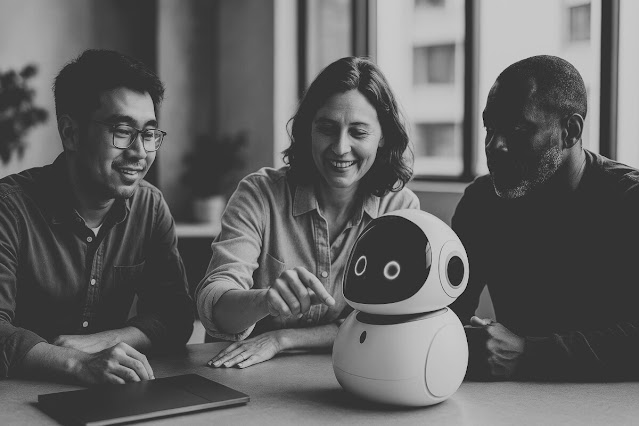
What actually emerged from the 2010s wasn't a replacement for the clinician and wasn't just a smarter self-help app either. It was something in between: mood-tracking wearables, daily check-in agents, predictive tools flagging risk before a crisis, a layer of AI-mediated attention sitting alongside human care rather than instead of it. The central problem this whole series has been circling since Wundt first put a stopwatch to a thought, whether a process can be measured, modelled, and mediated without losing whatever made it matter in the first place, hadn't been solved by the empathic turn. It had just gotten a great deal more consequential, because for the first time the mediating system could read exactly how you felt about the question while it was still being asked.
- American Psychological Association. (2025). Ethical principles of psychologists and code of conduct.
- Denecke, K., Bamidis, P., Bond, C., Gabarron, E., Househ, M., Lau, A. Y. S., Mayer, M. A., Merolli, M., & Hansen, M. (2015). Ethical issues of social media usage in healthcare. Yearbook of Medical Informatics, 10(1), 137–147.
- Fitzpatrick, K. K., Darcy, A., & Vierhile, M. (2017). Delivering cognitive behavior therapy to young adults with symptoms of depression and anxiety using a fully automated conversational agent (Woebot): A randomized controlled trial. JMIR Mental Health, 4(2), e19.
- Floridi, L., et al. (2018). AI4People: An ethical framework for a good AI society. Minds and Machines, 28(4), 689–707.
- Inkster, B., Sarda, S., & Subramanian, V. (2018). An empathy-driven, conversational artificial intelligence agent (Wysa) for digital mental well-being: Real-world data evaluation. JMIR mHealth and uHealth, 6(11), e12106.
- Picard, R. W. (1997). Affective computing. MIT Press.
- Picard, R. W. (2010). Affective computing: From laughter to IEEE. IEEE Transactions on Affective Computing, 1(1), 11–17.
- Weizenbaum, J. (1966). ELIZA: A computer program for the study of natural language communication between man and machine. Communications of the ACM, 9(1), 36–45.
AI tools were used in the production of this essay - for research support and final-stage formatting. Every fact and source is independently verified; the analysis and writing are the author's own.