Digital Psychiatry and the Web: Minds Online (1980s–2000s)
The last chapter closed on an open question: once care can travel down a wire, how much further is it to a wire with no one real at the other end? By the 1990s, one corner of psychology had already found out, almost by accident. Cognitive behavioural therapy was built from the start as a structured, step-by-step, teachable method rather than an open-ended relationship, and it turned out to be unusually well suited to being delivered by software instead of a person (Marks, Shaw, & Parkin, 1998). Programs like Beating the Blues and MoodGYM offered real CBT modules, working through real coping strategies, with no clinician anywhere in the loop. This wasn't the ELIZA effect in disguise. The techniques were genuine and the outcomes were measurable. What made it possible wasn't a clever simulation of empathy. It was that CBT had always been closer to instruction than to conversation, and instruction, unlike conversation, was something software could actually do.
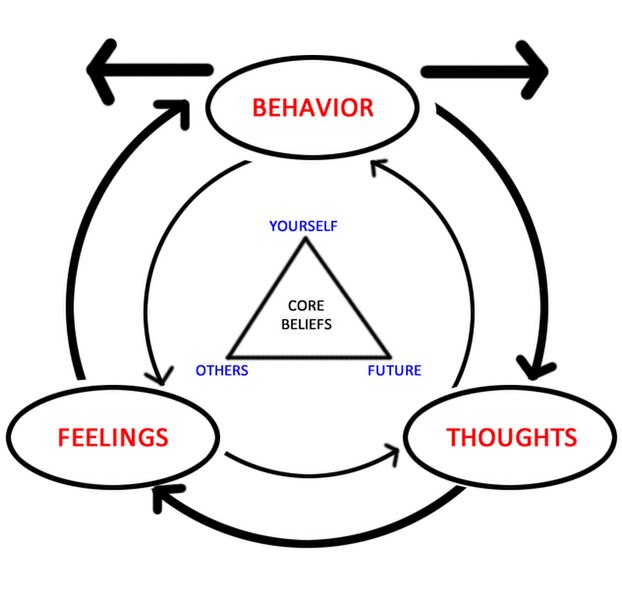

The Rise of Online Communities
Software wasn't the only thing filling the space technology had opened up. As the internet reached ordinary homes through the 1980s and 90s, people found each other on bulletin boards, mailing lists, and early forums to talk about anxiety, depression, trauma, and grief, often for the first time outside a clinical setting at all (Walther, 1996). These weren't therapy. No one was administering anything. But they were the first evidence that meaningful psychological support could form in a space with no institution behind it whatsoever. Not a hospital, not a program, just other people typing. That fact matters more in hindsight than it seemed to at the time: it's the direct ancestor of every peer-support app and mental-health subreddit that exists now.
From Pilot Projects to Mainstream Practice
The telepsychiatry pilots of the 1950s and 60s had proven a narrow claim: that care could survive a screen. By the 1990s and early 2000s, a much larger body of research had confirmed something broader, that virtual mental health care could match in-person therapy on diagnostic accuracy, treatment outcomes, and patient satisfaction, not just approximate it (Hilty et al., 2003; Hilty et al., 2013), and that it did so more cheaply and at greater scale (Bashshur & Shannon, 2009; Yellowlees et al., 2010). That evidence base is what turned a scattering of pilot programs into policy. The American Telemedicine Association and the American Psychiatric Association issued formal best-practice guidelines for video-based care, and confidentiality standards were rewritten to hold remote sessions to the same bar as in-person ones (Yellowlees et al., 2010). What had been an experiment for two decades became, quietly, infrastructure.
Awareness and Access
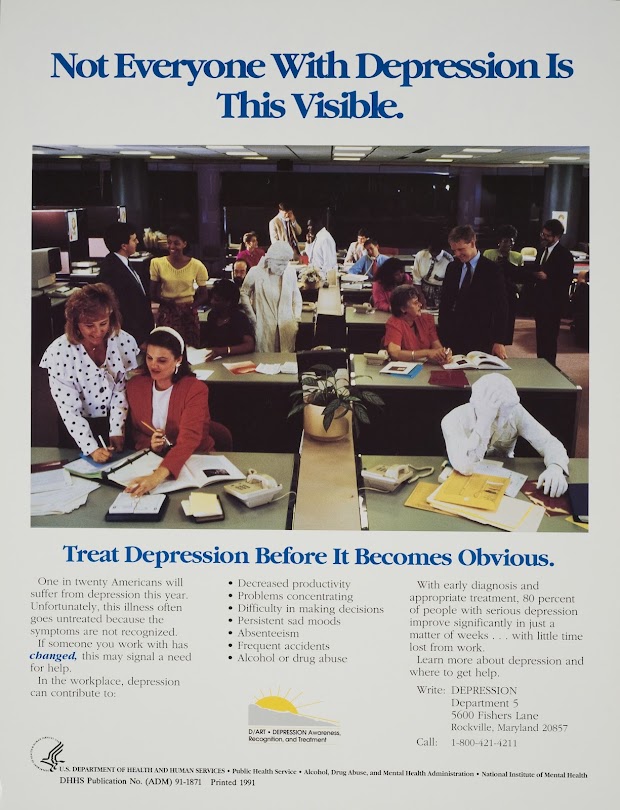
The same years saw mental health starting to become visible in public in a way it hadn't been before. A 1991 U.S. National Institute of Mental Health campaign used ghost-like illustrations of office workers to make an uncomfortable point, that depression is often invisible precisely to the people around someone experiencing it, and paired the image with a national helpline number (National Institute of Mental Health, 1991). It's a small, analogue artifact next to CBT software and telepsychiatry networks, but it belongs in the same story: destigmatisation and digitisation were happening at the same time, each making the other easier. It is harder to feel ashamed of using an online tool for a condition a national poster campaign has just told you is common.
What Changed, and What Didn't
By the end of this period the internet had stopped being just a channel mental health care travelled through and had become a place it actually happened: forums, structured self-help programs, remote consultations, public campaigns, all operating at once. But it matters to be precise about what had and hadn't been proven. Software had shown it could deliver a manualized, well-defined technique like CBT convincingly. It had not shown it could replace the open-ended, responsive relationship a telepsychiatry session or a peer-support thread still depended on. That distinction, between a technique that can be automated and a relationship that can only be mediated, is the exact fork in the road the next chapter walks straight into, when AI systems start trying to do both at once.
- Bashshur, R. L., & Shannon, G. W. (2009). History of telemedicine: Evolution, context, and transformation. Mary Ann Liebert, Inc.
- Hilty, D. M., Liu, W., Marks, S. L., et al. (2003). Effectiveness of telepsychiatry: A brief review. Canadian Psychiatric Association Bulletin, 35(4), 10–17.
- Hilty, D. M., Ferrer, D. C., Parish, M. B., Johnston, B., Callahan, E. J., & Yellowlees, P. M. (2013). The effectiveness of telemental health: A 2013 review. Telemedicine and e-Health, 19(6), 444–454.
- Marks, I. M., Shaw, S., & Parkin, R. (1998). Computer-assisted treatments of mental health problems. Clinical Psychology: Science and Practice, 5(2), 151–170.
- National Institute of Mental Health. (1991). Not everyone with depression is this visible [Public health campaign poster]. U.S. National Library of Medicine.
- Walther, J. B. (1996). Computer-mediated communication: Impersonal, interpersonal, and hyperpersonal interaction. Communication Research, 23(1), 3–43.
- Yellowlees, P. M., Shore, J. H., Roberts, L., et al. (2010). Practice guidelines for videoconferencing-based telemental health. Telemedicine and e-Health, 16(10), 1074–1089.
AI tools were used in the production of this essay - for research support and final-stage formatting. Every fact and source is independently verified; the analysis and writing are the author's own.