Looking Ahead: The Future of Mind and Machine
Every technology in this series so far has been retrospective, something to explain now that it's settled history. This chapter isn't that. What follows is more speculative than anything before it, built on where current research is heading rather than what's already been proven. Machine-learning models are being trained to read speech patterns, sleep cycles, and biometric and social data for signs of a mood shift before the person experiencing it has noticed one themselves (Picard, 2010; Floridi et al., 2018). That's a genuine capability, not a marketing claim. It's also a capability with an uncomfortable question folded inside it that the field hasn't answered yet. What happens when a system knows you're at risk before you do, and what obligations does that knowledge create for whoever's holding it?
Predictive and Preventive Care
Scale that up and the same question gets larger, not smaller. The models being built don't stop at individuals. Some are designed to model mental health trends across whole populations, simulating how a policy change might ripple through public wellbeing before it's ever implemented (Floridi et al., 2018). That's a genuinely useful shift, reactive care becoming preventive care. It's also a shift that moves the decision-making further from the person being modelled and closer to whoever controls the model. Prediction is not neutral just because it's accurate. A system that flags risk can also be a system that flags people, for insurers, employers, schools, and the technology's usefulness for prevention says nothing on its own about who gets access to what it knows.
Embodied AI: Robots as Companions and Caregivers
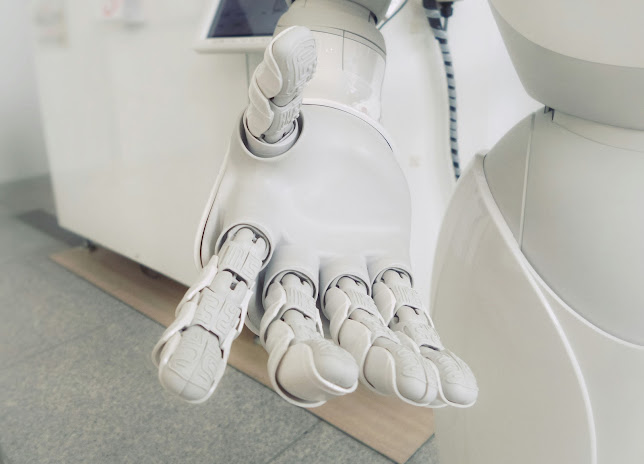
The frontier isn't only predictive. Some of it is physically in the room. Socially assistive robots, from humanoid platforms like Pepper to therapeutic companions like the seal-shaped PARO, are already working in aged-care settings, offering comfort, cognitive stimulation, and something that reads as companionship (Broadbent, Stafford, & MacDonald, 2009; Kachouie, Sedighadeli, Khosla, & Chu, 2014). Newer versions hold eye contact and time their gestures to feel less mechanical. The honest case for these systems is real: for someone isolated and under-resourced, a responsive presence between human visits is better than no presence at all. The honest tension is just as real. A robot companion is cheaper to deploy than more staff, and cheaper tends to win budget arguments regardless of which option is actually better for the person receiving care. Comfort and cost-cutting can look identical from a funding spreadsheet, even when they aren't.
Super-Intelligent Systems and Ethical Horizons
Further out still are what researchers sometimes call integrative or "super-thinking" systems, AI designed to combine psychology, neuroscience, medical data, and social trend data at a scale no individual clinician could hold in mind at once (Floridi et al., 2018). What such a system might generate, new therapeutic models, previously invisible risk patterns, individualised long-term care trajectories, is genuinely promising and genuinely unproven. The ethical questions it raises are the same ones this chapter keeps circling, just sharper. What happens when an algorithm sees vulnerability before a clinician does, who regulates a system built to detect risk, and how do we stop a tool built to support human judgment from quietly starting to substitute for it (American Psychological Association, 2025)? None of this has a settled answer yet. Anyone claiming otherwise is selling something.
The Question This Series Has Actually Been Asking
Six chapters ago, Ada Lovelace wrote that a machine has no pretensions to originate anything. It can only do what it is told. Alan Turing spent his career arguing that the distinction mattered less than people assumed. Weizenbaum built a program that proved, by accident, that most people would extend real trust to a machine regardless of which of them was right. Telepsychiatry showed that real understanding could survive being carried through a wire. CBT software showed that a well-defined technique could be automated entirely, cleanly, without controversy. And the empathic turn showed that a system could get convincingly good at seeming to understand, whether or not anything behind the interface actually did.
None of that settles Lovelace's objection. It just makes it matter more, because the stakes attached to the answer keep growing. From a stopwatch in a Leipzig lab to a robot in an aged-care ward to a model that might flag a mental health crisis before anyone involved has said a word about it. This series doesn't end with a resolution, because there isn't one yet. What it ends with is the same bet every chapter has quietly been running on: the space between a thought and a mechanism is worth studying carefully, precisely because it has never once turned out to be as wide as everyone confidently assumed at the start.
- American Psychological Association. (2025). Ethical principles of psychologists and code of conduct.
- Broadbent, E., Stafford, R., & MacDonald, B. (2009). Acceptance of healthcare robots for the older population: Review and future directions. International Journal of Social Robotics, 1(4), 319–330.
- Floridi, L., Cowls, J., Beltrametti, M., Chatila, R., Chazerand, P., Dignum, V., Luetge, C., Madelin, R., Pagallo, U., Rossi, F., Schafer, B., Valcke, P., & Vayena, E. (2018). AI4People: An ethical framework for a good AI society. Minds and Machines, 28(4), 689–707.
- Kachouie, R., Sedighadeli, S., Khosla, R., & Chu, M. T. (2014). Socially assistive robots in elderly care: A mixed-method systematic literature review. International Journal of Human–Computer Interaction, 30(5), 369–393.
- Picard, R. W. (2010). Affective computing: From laughter to IEEE. IEEE Transactions on Affective Computing, 1(1), 11–17.
AI tools were used in the production of this essay - for research support and final-stage formatting. Every fact and source is independently verified; the analysis and writing are the author's own.