The Rope and the Algorithm
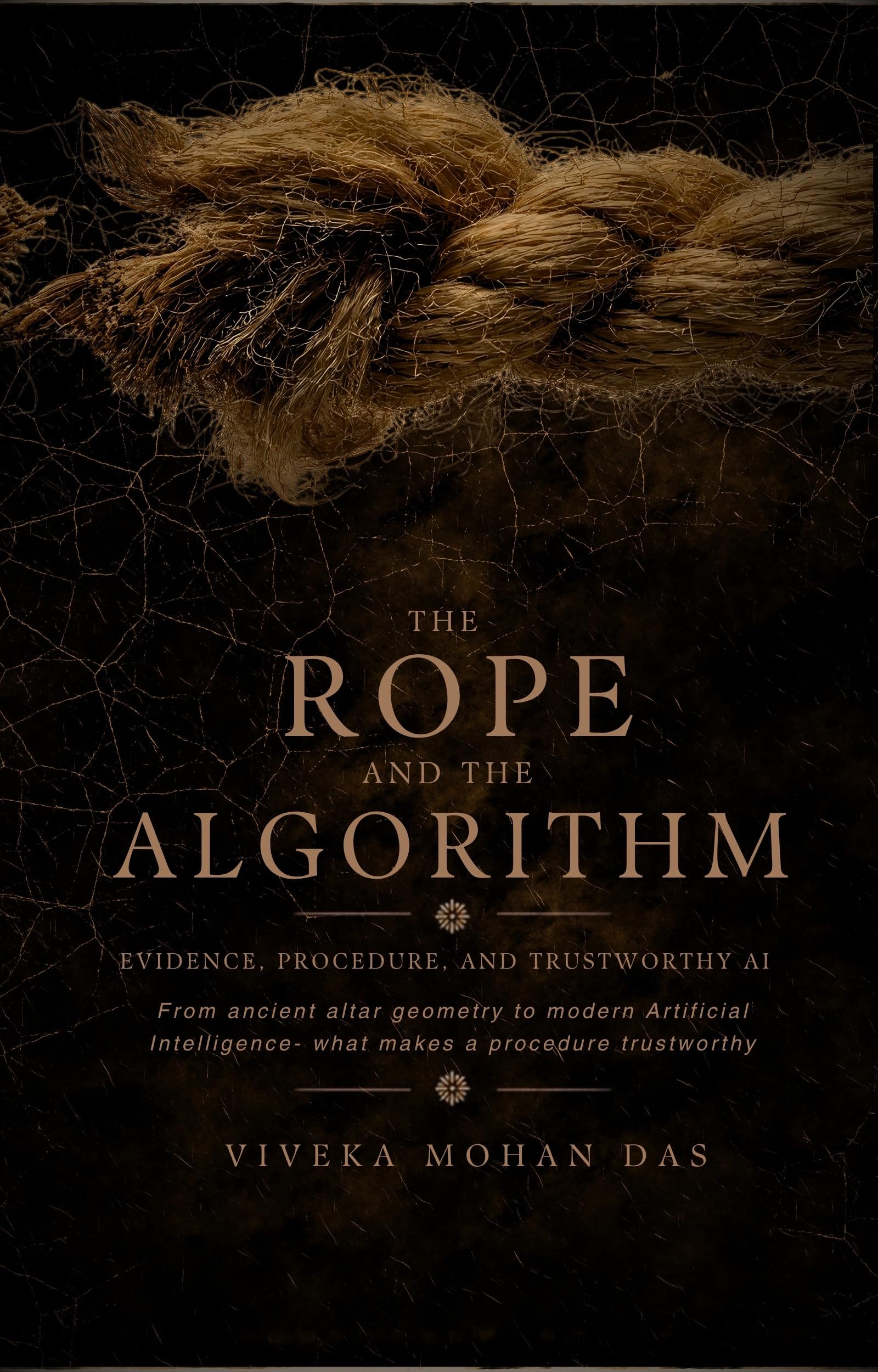
Before we trust a machine, we should ask what makes any procedure trustworthy. The Rope and the Algorithm is not a claim that ancient India invented artificial intelligence. It is an inquiry into what any reliable procedure requires, whether it is carried out with a cord on prepared ground or with data on a server: a stated purpose, known conditions, visible checks, a defined sense of error, and an accountable route for correction.
The book begins with the Śulba Sūtras, the Sanskrit construction texts behind the Vedic rope-and-peg method for laying out fire altars. It treats them as historical constructional sources, not as early computer programs and not as ancestors of modern computing. Their value here is the way a spoken rule is joined to material action: a dependable result rests on specification, instruments, trained practice, checking, and shared standards, not on a formula alone.
From that starting point the book turns to contemporary AI and asks the same questions in a harder setting. What must a system make visible before reliance on its outputs is justified? What counts as error, and who carries the cost of it? Who can inspect, contest, and correct a result, and who is answerable when it fails?
Written for executives, technologists, researchers, and policy readers who want a rigorous account of trustworthiness, not a story of technological descent.
Inside the book
This book intends to show how procedures become trustworthy: not because they appear correct, but because their purpose, conditions, limits, errors, and routes of correction can be examined.
It begins with the Śulba Sūtras, Sanskrit constructional texts associated with Vedic Śrauta ritual, because they make procedure unusually concrete. The book treats them as historical constructional sources, not as computer programs, and not as technological ancestors of modern AI.
Their value for this argument lies in the way verbal rules are joined to material action. A reliable result depends on specification, instruments, trained practice, checking, correction, and shared standards – not on a formula alone.
This book moves in three stages.
First, it studies the Śulba Sūtras as historical constructional procedures – what kind of evidence survives, and how a procedure becomes reliable when it must be carried out with instruments, bodies, materials, memory, and judgement.
Second, it examines what procedures reveal when they do not produce perfect results at once: approximation, error, correction, repetition, and reproducibility.
Third, it turns to modern AI. The rope is the first instrument through which the problem becomes visible. The algorithm is the modern form in which the same problem returns.
The question introduced in the Author’s Note – how a procedure becomes trustworthy when its result cannot be accepted on appearance alone – begins here, with a rope.
Not a rope that measured the cosmos by revealing a hidden universal machine. A rope that measured the ground, the angle of a line, the side of a square, and the relation among parts of a figure. Its reach was modest. Its consequences were not.
The cord belonged to a ritual and textual setting. Around the first millennium BCE, Vedic ritual specialists developed and transmitted procedures for constructing altars. A figure that merely looked right could still fail if its relations were wrong.
Excerpted from the book’s front matter and opening chapter. Read the full sample on Amazon →
Corrections & Sources
The research process, source log and any corrections for this edition are kept here, on this page, rather than off-site.
The full chapter-by-chapter research record, evidence boundaries, and consolidated references for this edition. Read the source log →
No corrections issued yet for this edition.
None published. This slot stays empty until Viveka has real, attributed responses to place here.