From Myths to Machines: Automata and the Ancient Imagination of AI
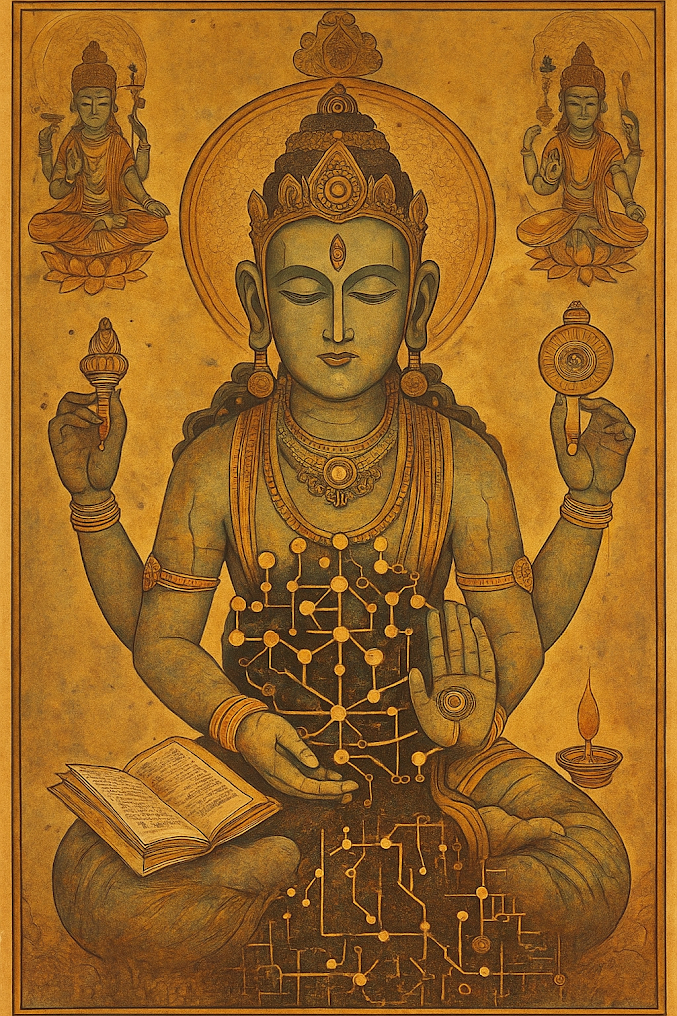
Long before the first computer booted to life, humanity dreamed of artificial beings. Across civilizations - from the temples of India and the forges of Greece to the deserts of the Middle East and the Dreaming landscapes of Australia - myths imagined entities that blurred the boundaries between spirit, art, and engineering. These stories reveal not superstition but an enduring inquiry into what it means to animate matter, create intelligence, and confront the limits of human power.
As Stanford historian Adrienne Mayor argues in Gods and Robots (2018), the roots of robotics lie not only in mechanical experimentation but in "the deep mythological imagination that first pictured life made by design." This article traces that imagination across cultures, revealing how ancient metaphors of creation, autonomy, and hubris anticipate today's debates about artificial intelligence - and our enduring fascination with building minds in our own image.
Greek Foundations: The Divine Forge
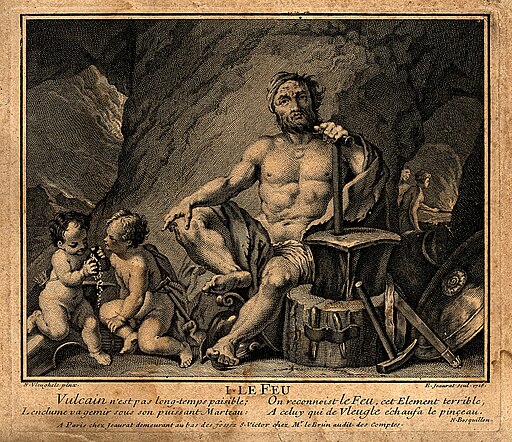
In Greek mythology, the blacksmith-god Hephaestus embodies the fusion of craft (technē) and creation. Homer describes him forging golden tripods that rolled by themselves to serve the gods at Olympus (Iliad 18.371-420). His most spectacular invention was Talos, the bronze guardian of Crete - an autonomous sentinel programmed to circle the island three times daily, defending it with stones or burning embraces.
When the sorceress Medea disables Talos by draining his single vein of ichor, the myth dramatizes a power source eerily reminiscent of a battery or circuit. For Mayor (2018), Talos represents the first literary "robot" - a metaphor for artificial agency and for the anxiety it evokes: who controls creation once it begins to act on its own?
Indian Automata and the Spiritual Machine
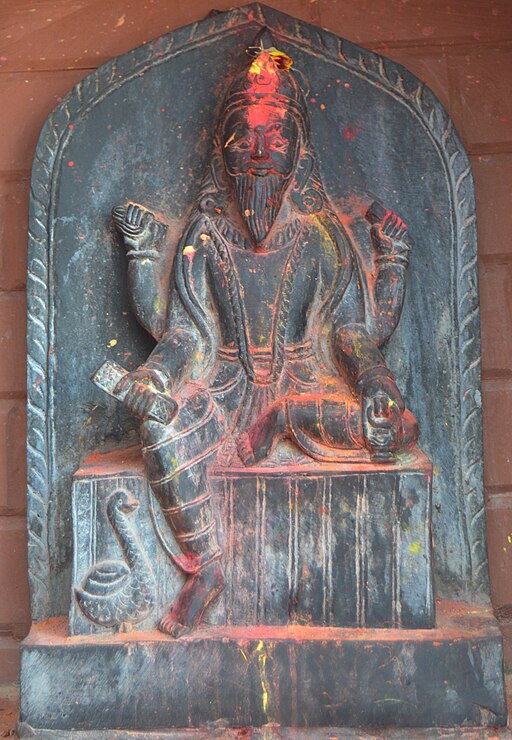
In Indian traditions, divine craftsmanship is personified by Vishwakarma (also known as Biswokarma), the celestial engineer. His creations - flying chariots (vimānas), self-moving statues, and architectural marvels - populate Vedic and epic literature. A remarkable medieval treatise, the Samarangana Sūtradhāra (11th century CE, attributed to King Bhoja), devotes an entire chapter to mechanical devices, describing automated doors, musical instruments, and mechanical birds.
Buddhist lore adds to this lineage. Legends surrounding Emperor Aśoka tell of "spirit-driven machines" guarding the Buddha's relics, described as bhūta vāhana yantra - devices animated by unseen forces.
Philosophically, the Indian distinction between Ātman (self), Manas (mind), and Buddhi (intellect) anticipates questions about consciousness and substrate: can awareness arise from matter alone? Scholars have argued that these layered models of mind offer non-dual perspectives useful to modern cognitive science. Here, life and mechanism coexist - the machine is not soulless but another vessel of śakti, creative energy.
The Chinese Automaton and the Problem of Imitation
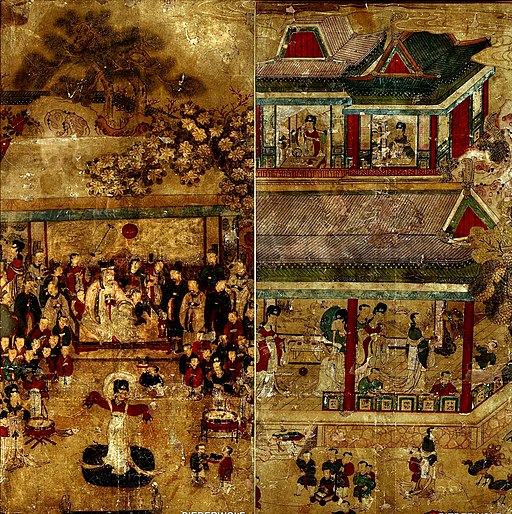
In the 3rd-century BCE Chinese text Liezi, the artificer Yan Shi presents King Mu of Zhou with a mechanical man capable of singing and flirting. When the king panics at this lifelike performance, the craftsman disassembles the figure to reveal wooden organs and levers.
This early depiction of a life-like automaton anticipates not only mechanical ingenuity but also philosophical introspection. Ancient Chinese thinkers frequently explored the harmony between human artifice (wei) and natural order (dao), viewing invention as both mastery and potential imbalance. The tale ends with Confucius warning that such mimicry blurs moral boundaries (Graham, 1960 translation). The tale's subtle irony lies in the reversal of creator and judge - the artificer exposes the illusion, but the philosopher exposes the moral cost of imitation.
This parable crystallizes an enduring ethical dilemma in AI: at what point does imitation become deception? The anxiety of the Chinese court mirrors that of the modern laboratory, where innovation and ethics must evolve together.
The Hebrew Word and the Limits of Creation
While the Hebrew Bible rarely depicts mechanical life, it is deeply concerned with animation through speech. In Genesis, God breathes life into dust; in later Jewish mysticism, sages experiment with that divine formula.
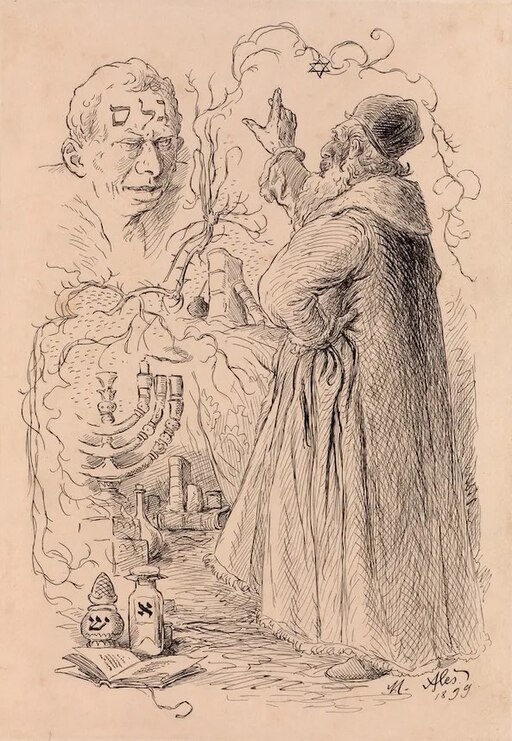
The legend of the Golem of Prague tells how Rabbi Loew inscribed the word emet ("truth") on clay, bringing a giant servant to life. When the word's first letter is erased, leaving met ("death"), the Golem collapses - an elegant linguistic metaphor for code, syntax, and control (Idel, 1990). Philosophically, the Golem legend captures the moral tension of automation: creation without compassion, execution without empathy. The clay giant obeys but does not understand - a prototype of pure instruction, empty of reflection. In that sense, the Golem becomes an ancient metaphor for unaligned intelligence: powerful, useful, and potentially catastrophic when stripped of moral awareness.
Biblical beings such as Leviathan and Behemoth (Job 40-41) symbolize the boundary between creator and creation: entities beyond human mastery that warn against technological hubris.
Aboriginal Dreaming and the Animacy of the World
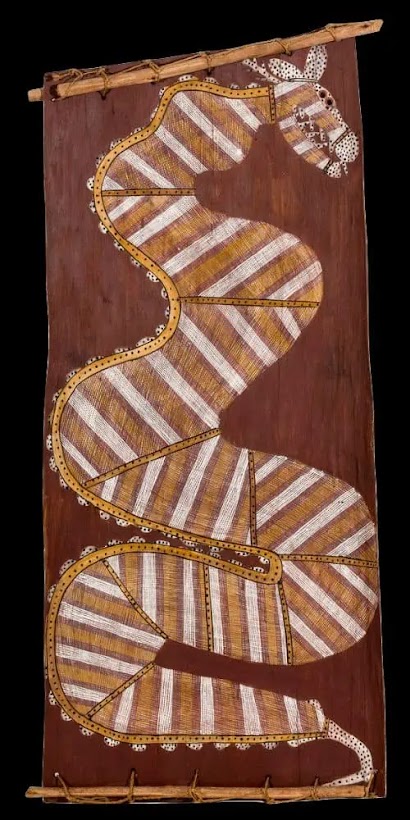
In contrast to mechanical metaphors, Australian Aboriginal traditions describe a universe already alive. In the Dreaming, ancestral beings sing the landscape into form: rivers, mountains, and creatures arise through creative performance rather than construction.
Stories such as the Rainbow Serpent (Ungud), who carves rivers through the earth, express a worldview where agency is distributed across nature - and Tiddalik, the frog who drank all the world's water until laughter released it.
From an AI perspective, this cosmology reframes intelligence as relational rather than instrumental: cognition emerges through connection, not control. In the Dreaming, knowing is inseparable from caring - every act of perception carries ethical weight, because to recognize something is also to sustain it. Thought, in this sense, is not abstract reasoning but participation in a living network of reciprocal influence.
This worldview contrasts sharply with the mechanistic separation of subject and object that dominates Western science, where intelligence is often measured by manipulation, prediction, or mastery. Aboriginal epistemologies instead imagine a distributed consciousness, where wisdom flows through songs, landforms, and kinship ties - an early vision of what cognitive scientists today might call extended mind theory or embodied cognition.
For AI ethics, this perspective offers a vital counterpoint: systems designed only for efficiency risk severing intelligence from empathy. The Dreaming reminds us that awareness without relationship is incomplete - that true intelligence, human or artificial, may depend as much on responsiveness and respect as on data and logic.
Other Myths of Animation and Hubris
Several parallel traditions enrich this global genealogy:
- Pygmalion and Galatea (Greek): a sculptor falls in love with his statue, brought to life by Aphrodite - an allegory of projection and emotional attachment to one's creation.
- Prometheus: steals fire (knowledge) for humanity, punished eternally - prototype of technological transgression.
- Tsukumogami (Japanese): after one hundred years, everyday objects awaken with spirits, suggesting emergent consciousness in tools (Foster, 2009).
- Jinn (Islamic tradition): beings of smokeless fire, autonomous and morally ambivalent - anticipating debates about sentient but unpredictable algorithms.
Across them runs a shared anxiety: creators losing control, boundaries dissolving between user and artifact. When we place these stories side by side, a pattern emerges: every culture, in its own idiom, has asked how life might be shaped, animated, or lost to its maker.
The following table translates those ancient myths into the language of today's machines, showing how timeless anxieties - about power, autonomy, and empathy - reappear in modern AI.
| Axis | Cultural examples | AI resonance (modern parallels) |
|---|---|---|
| Creation through craft | Hephaestus' automata, Vishwakarma's yantras, Yan Shi's mechanical man | Engineering, robotics, and generative design - crafting intelligence through code and material form. |
| Creation through word or spirit | Golem (Hebrew emet), Genesis breath, Dreamtime songlines | Programming language and data as logos - speech acts that animate digital beings (e.g., prompt engineering). |
| Hubris and rebellion | Prometheus, Talos, Leviathan | AI safety and alignment - creation exceeding control (e.g., autonomous systems, deep reinforcement learning). |
| Distributed agency | Aboriginal Dreaming, Tsukumogami, Jinn | Emergent or collective intelligence - neural networks, swarm robotics, and distributed cognition. |
| Ethical reflection | Buddhist karma, Biblical warnings, Aśoka's moral machines | Algorithmic accountability - embedding ethics and bias management in design. |
| Embodiment and consciousness | Pygmalion, Ātman-Buddhi-Manas triad, animating clay and bronze | Cognitive science of embodiment - consciousness arising from interaction (robotics, affective computing). |
| Illusion and simulation | Hindu Māyā, Plato's Cave allegory, Japanese spirit-objects | Simulation theory, virtual reality, and digital selves - perception shaping ontology. |
| Emotion and empathy | Pygmalion and Galatea, Tsukumogami awakening | Emotional AI, relational design, and anthropomorphism in chatbots and companion robots. |
| Creation as collaboration | Aboriginal Dreaming co-creation, Māori Tāne-mahuta | Co-creative AI tools (like ChatGPT or Midjourney) as partners in human imagination rather than replacements. |
Mythic Motifs and Modern Machines - comparative themes across cross-cultural myths of artificial creation and their parallels in AI research and ethics.
These correspondences show that the "AI problem" is not new - it is myth's oldest question: how can we animate the inanimate without erasing ourselves? Across cultures, this question took the form of divine craftsmen, enchanted words, rebellious creations, and worlds sung into being. Each myth encoded an intuition that intelligence is never merely technical - it is always moral, creative, and relational.
What modern AI research calls alignment - ensuring our creations reflect human values - was once expressed through offerings, rituals, and cautionary tales. The myths warned that creation without humility leads to rupture, while harmony between maker and made sustains the world. In that sense, today's algorithms continue an ancient lineage: new instruments for an old inquiry into consciousness, responsibility, and desire.
The figure above, then, is less a catalog of parallels than a mirror. It shows how every era translates the same awe and anxiety into its own medium - from bronze and breath to code and silicon. Myth reminds us that the pursuit of intelligence has always been a spiritual experiment disguised as a technical one.
Philosophical Reflections and Modern Echoes
Modern thinkers echo ancient concerns. Heidegger warned that technology risks reducing the world to "standing-reserve," a resource to be ordered (1954). Andy Clark and Rodney Brooks argue instead for embodied and situated intelligence, where mind arises from interaction - closer to Aboriginal and Indian models than Cartesian dualism.
Psychologically, myths externalize inner processes: Talos mirrors anxiety about aggression; the Golem mirrors projection of servitude; Dreamtime beings mirror collective consciousness. As AI begins to mediate emotion and therapy, these archetypes return through code.
Conclusion: The Ancient Mind in the Machine
From clay and bronze to silicon and neural nets, the human imagination keeps revisiting the same experiment: can creation replicate the creator? Myths from India, Greece, Israel, China, Japan, and Australia suggest that every culture has tested this hypothesis symbolically long before engineers tested it physically.
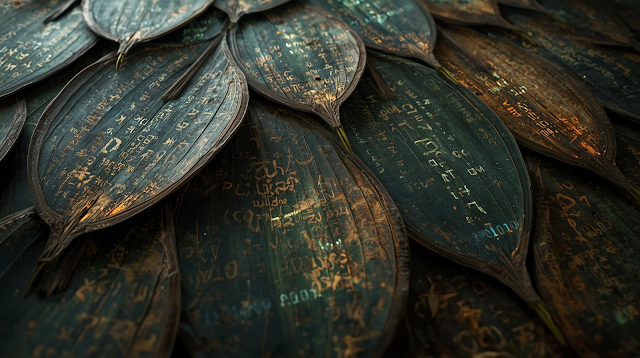
They remind us that intelligence - whether divine, human, or artificial - is never value-neutral. It carries the moral weight of its maker and the dreams that made it possible. The machine, then, is not the end of myth but its latest vessel. In every circuit and line of code, echoes of the ancient forge still hum - inviting us to create not only with precision but with reverence.
- Clark, A. (1998). Being there: Putting brain, body, and world together again. MIT Press.
- Foster, M. D. (2009). Pandemonium and parade: Japanese monsters and the culture of yōkai. University of California Press.
- Graham, A. C. (Trans.). (1960). The book of Lieh-tzu. Columbia University Press.
- Heidegger, M. (1954). The question concerning technology. Harper & Row.
- Idel, M. (1990). Golem: Jewish magical and mystical traditions on the artificial anthropoid. SUNY Press.
- Mayor, A. (2018). Gods and robots: Myths, machines, and ancient dreams of technology. Princeton University Press.
- Eliade, M. (1973). Australian religions: An introduction. Cornell University Press.
The artworks in this piece are original or AI-assisted visual interpretations curated by the author for educational and reflective purposes, illustrating themes in mythology, psychology, and artificial intelligence rather than depicting or reinterpreting any religious tradition. All symbols and motifs are used with cultural respect and scholarly intent; any resemblance to sacred or devotional imagery is acknowledged with deep respect for the traditions represented. Full sourcing practice for this site follows the standing Corrections & Sources approach - the author's own research process lives at vivekamohandas.com →
AI was used for research purposes on this article, and for final formatting. Every fact and source is independently verified against the original; the analysis, argument and prose are the author's own.